

Desalination represents the process of removing salt and minerals from seawater or brackish water to produce freshwater suitable for human consumption, agriculture, and industrial use. In 2026, this technology has become more critical than ever as global water scarcity affects over 2 billion people worldwide, while climate change intensifies droughts and depletes traditional freshwater sources. Modern desalination systems now incorporate advanced technologies like energy recovery devices, solar power integration, and chemical-free treatment processes that reduce energy consumption by up to 70% compared to conventional methods, making freshwater production both economically viable and environmentally sustainable for coastal communities, resorts, and industries facing acute water shortages.
Why are outdated desalination systems draining your operational budget? #
Traditional desalination systems consume 7-10 kWh per cubic meter of water produced, creating crushing energy expenses that can reach €3-6 per cubic meter when electricity costs are factored in. For a resort using 50 cubic meters daily, this translates to €54,750-109,500 in annual water costs alone, not including frequent pump replacements every two years due to corrosion, membrane failures from inadequate pre-treatment, and emergency service calls to remote locations. The solution lies in upgrading to modern energy recovery technology that reduces consumption to just 3 kWh per cubic meter, cutting operational costs by 70% while extending equipment lifetime through super duplex steel components and automated fresh flush cycles that preserve membranes without chemicals.
What makes chemical-dependent water treatment a liability risk you cannot afford? #
Chemical dosing in conventional desalination creates multiple failure points: staff exposure to hazardous anti-scalants during handling, potential contamination of produced water if dosing systems malfunction, and environmental compliance violations that can result in hefty fines or facility shutdowns. Properties in pristine coastal locations face particular scrutiny from environmental agencies and eco-conscious guests who expect sustainable operations. The breakthrough solution involves implementing chemical-free desalination systems that use automated fresh water flush cycles and optimized recovery ratios to prevent scaling naturally, eliminating chemical storage, handling risks, and the ongoing expense of chemical purchases while ensuring consistently safe water production.
What is desalination and why is it more important than ever in 2026? #
Desalination is the process of removing dissolved salts, minerals, and contaminants from seawater or brackish water to produce freshwater suitable for drinking, irrigation, and industrial applications. The technology works by forcing water through specialized membranes at high pressure (typically 50 bar for seawater) that filter out particles as small as 0.0001 microns, including salts, bacteria, and viruses.
In 2026, desalination has become increasingly vital due to several converging factors. Traditional freshwater sources are depleting rapidly, with aquifers being overdrawn and rivers running dry in many coastal regions. Climate change has intensified this crisis, creating longer droughts and more unpredictable rainfall patterns. Meanwhile, coastal populations continue to grow, placing unprecedented demand on limited freshwater resources.
The economics of water scarcity make desalination essential for many communities. In remote coastal areas, trucked water can cost €10-20 per cubic meter, while municipal water in water-stressed regions reaches €5-10 per cubic meter. Modern desalination technologies now produce freshwater for €1-3 per cubic meter over a 15-year operational period, making it the most cost-effective solution for a reliable water supply in coastal areas.
What are the most energy-efficient desalination technologies available today? #
The most energy-efficient desalination technologies in 2026 center around advanced energy recovery systems that capture and reuse the pressure from concentrated brine discharge. These systems achieve energy consumption as low as 2.7 kWh per cubic meter for seawater desalination, compared to 7-10 kWh per cubic meter for conventional reverse osmosis systems without energy recovery.
Energy recovery devices work by transferring the hydraulic energy from the high-pressure brine stream back to the incoming seawater feed. This process recovers up to 70% of the energy that would otherwise be wasted, dramatically reducing both operational costs and carbon footprint. The technology, already standard in large-scale facilities, has been successfully adapted for small-scale applications producing 5-150 cubic meters daily.
Modern efficient desalination systems also incorporate variable frequency drives that adjust pump speeds based on water demand, high-efficiency membranes that operate at lower pressures, and intelligent control systems that optimize performance based on feed water conditions. These innovations work together to minimize energy consumption while maximizing water production and membrane lifetime.
How does solar-powered desalination work and what makes it sustainable? #
Solar-powered desalination harnesses photovoltaic energy to drive the reverse osmosis process, creating a completely renewable water production system. Plug and play solar desalination systems connect solar panels directly to specialized pumps that pressurize seawater through membrane filters, producing 5-100 cubic meters of freshwater daily without grid electricity.
The sustainability of solar desalination stems from multiple factors. First, it eliminates the carbon emissions associated with grid-powered systems, reducing CO2 output by 18-100 tons annually depending on system size. Second, these systems operate without batteries in some configurations, using elevated water buffers for energy storage instead, which eliminates toxic battery waste and replacement costs. Third, the modular design allows systems to scale with demand, preventing overbuilding and resource waste.
Advanced solar desalination incorporates gravity-fed designs that use solar power to pump seawater to elevated tanks during sunny periods. The stored water then flows through reverse osmosis membranes using gravitational pressure, enabling 24/7 operation even when solar energy is unavailable. This innovative approach achieves continuous water production while maintaining the environmental benefits of renewable energy.
What’s the difference between traditional and modern desalination systems? #
Traditional desalination systems rely on energy-intensive pumps without recovery mechanisms, consuming 7-10 kWh per cubic meter and requiring frequent chemical dosing to prevent membrane fouling. These systems typically use stainless steel pumps that corrode within two years in warm seawater environments, suffer from inadequate pre-treatment leading to membrane failures, and operate with basic on/off controls that waste energy during partial load conditions.
Modern desalination systems integrate three revolutionary improvements: energy recovery technology that reduces consumption to 3 kWh per cubic meter, chemical-free operation through automated fresh flush cycles, and advanced materials like super duplex steel or titanium that resist corrosion for 15+ years. Efficient desalination systems also feature remote monitoring capabilities, variable speed drives for optimal efficiency, and modular designs that simplify maintenance and expansion.
The operational differences are substantial. While traditional systems require constant chemical purchases, frequent pump replacements, and on-site technical expertise, modern systems operate autonomously with minimal intervention. GSM-based monitoring allows operators to track performance remotely, receiving alerts before problems escalate. This technological leap transforms desalination from a maintenance-intensive operation to a reliable, hands-off water supply solution.
Which desalination technology is best for small-scale applications? #
For small-scale applications producing 5-50 cubic meters daily, containerized reverse osmosis systems with energy recovery represent the optimal technology choice. These compact units arrive pre-assembled in 8 to 20-foot containers, enabling installation and commissioning within days rather than months. The plug-and-play design eliminates complex on-site construction while ensuring consistent performance across installations.
Small-scale systems benefit particularly from chemical-free operation since chemical handling and dosing become disproportionately complex and expensive at smaller volumes. Modern small-scale units use automated fresh water flush cycles to prevent bio-fouling and scaling, extending membrane life to 5-7 years without chemical cleaning. This approach reduces operational complexity while maintaining water quality that meets WHO drinking water standards.
The economics favor energy-efficient small systems due to their higher per-unit water costs. While large facilities might tolerate higher energy consumption due to economies of scale, small systems producing water at €3-5 per cubic meter cannot afford the 70% energy penalty of traditional technology. Energy recovery devices adapted for small-scale applications deliver the same efficiency benefits as large plants, making sustainable water production viable even for individual resorts or small communities.
How much does modern desalination technology cost to implement and operate? #
Modern desalination technology requires initial investments ranging from €40,000 for small efficient systems producing 11 cubic meters daily to €400,000 for large solar-powered installations generating 100 cubic meters daily. These costs include equipment, transportation, on-site installation, commissioning, and comprehensive operator training to ensure optimal performance from day one.
Operational expenses for modern systems are dramatically lower than traditional alternatives. A small efficient desalination system costs approximately €4,000 annually for electricity, filters, spare parts, and remote support, producing water at €1.50 per cubic meter over 15 years. Medium systems (44 m³/day) achieve €1.20 per cubic meter with €13,000 annual operating costs, while large systems (88 m³/day) reach €1.10 per cubic meter with €25,000 yearly expenses.
The financial comparison reveals compelling advantages: while trucked water costs €10-20 per cubic meter and conventional desalination runs €3-6 per cubic meter, modern energy-efficient systems deliver water for €1-3 per cubic meter including all investment and operational costs over 15 years. For a resort consuming 50 cubic meters daily, this represents annual savings of €73,000-146,000 compared to trucked water, with typical payback periods of 2.5-4 years.
How Elemental Water Makers helps with modern desalination technology #
We specialize in revolutionary desalination solutions that transform how coastal properties and communities access freshwater. Our proven technology, deployed in over 100 installations across 35 countries since 2012, delivers up to 70% energy savings compared to conventional systems through our proprietary energy recovery technology.
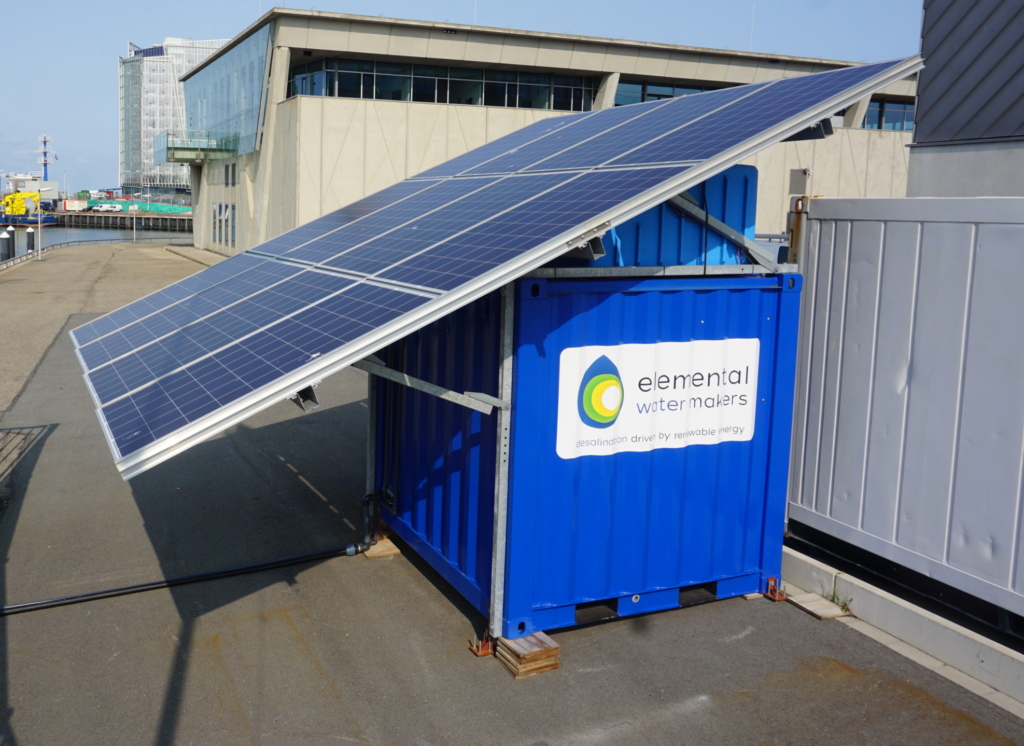
Our comprehensive desalination portfolio addresses every application need:
- Elemental Water Source: Off-grid solar-powered systems producing 5-100 m³ daily for remote locations without electrical infrastructure
- Efficient Water Maker: Grid-connected systems generating 11-88 m³ daily with minimal energy consumption for properties with existing power
- Plug-and-play design: Containerized units that install within days, not months
- Chemical-free operation: Automated fresh flush technology eliminates hazardous chemicals
- Remote monitoring: GSM-based systems enable oversight from anywhere
- 15+ year reliability: Super duplex steel components ensure decades of operation
We deliver complete project support from initial consultation through long-term operation. Our certified partners handle local design, installation, and commissioning while we provide one year of free operational support. With water production costs as low as €1-3 per cubic meter over 15 years, we make sustainable desalination accessible for resorts, villas, industries, and communities worldwide.
Ready to achieve water independence with modern desalination technology? Contact us for a free location-specific assessment and discover how our proven solutions can reduce your water costs by up to 75% while ensuring a reliable, sustainable freshwater supply for decades to come.
Frequently Asked Questions #
How long does it take to install a modern desalination system, and what site preparations are needed?
Modern containerized desalination systems can be installed and operational within 3-7 days, compared to 3-6 months for traditional built-on-site systems. Site preparation is minimal, requiring only a level concrete pad for the container, connections for seawater intake and brine discharge pipes, and electrical connections for grid-powered systems. Pre-assembled units arrive fully tested, eliminating complex on-site construction and allowing immediate water production once connected.
What happens to the concentrated brine discharge, and how can it be managed environmentally?
Modern desalination systems produce brine with 1.5-2 times the salt concentration of seawater, which must be properly dispersed to prevent environmental impact. Best practices include using diffuser systems that mix brine rapidly with seawater, locating discharge points in areas with strong currents, and monitoring salinity levels to ensure marine life protection. Some innovative applications use the mineral-rich brine for salt production, aquaculture, or as a resource for extracting valuable minerals like lithium and magnesium.
How do I determine the right system size for my water needs, and can systems be expanded later?
System sizing starts with calculating peak daily water consumption, typically 200-400 liters per person for resorts or 150-200 liters for residential use, then adding 20-30% safety margin for seasonal variations. Modern modular systems allow easy expansion by adding parallel units as demand grows, avoiding oversizing initial investments. A water audit analyzing current consumption patterns, future growth projections, and seasonal fluctuations provides the most accurate sizing recommendation.
What maintenance skills are required to operate modern desalination systems, and is remote support available?
Modern desalination systems require only basic maintenance skills like filter changes, pressure gauge readings, and visual inspections, which can be learned in a 2-3 day training program. Advanced diagnostics and troubleshooting are handled through remote monitoring systems that alert technical support teams to issues before they affect water production. Most suppliers offer comprehensive remote support packages including real-time monitoring, predictive maintenance alerts, and video-guided troubleshooting, eliminating the need for on-site technical expertise.
How do modern desalination systems perform in extreme weather conditions like hurricanes or heat waves?
Containerized desalination systems are designed to withstand extreme conditions, with reinforced steel containers rated for wind speeds up to 200 km/h and operating temperatures from 5°C to 45°C. During severe weather, systems can be temporarily shut down and secured, with automated fresh flush cycles protecting membranes during idle periods. Heat-resistant components and temperature-compensating controls maintain efficiency even during heat waves, while elevated installations or submersible intakes protect against storm surge damage.
What financing options exist for desalination projects, and how do I calculate return on investment?
Desalination projects qualify for various financing options including green energy loans, water infrastructure grants, and lease-to-own programs that spread costs over 5-10 years. ROI calculations compare total water production costs (including equipment, energy, maintenance) against current water supply expenses over the system’s 15-20 year lifespan. Most projects achieve payback within 2.5-4 years when replacing trucked water or expensive municipal supplies, with some locations qualifying for carbon credits or sustainability incentives that further improve financial returns.