

A reverse osmosis desalination system works by forcing seawater through a semi-permeable membrane under high pressure, physically separating salt and other dissolved solids from fresh water. The result is clean water that meets WHO drinking water standards, produced without chemicals or complex moving parts. Below, we answer the most common questions about how these systems work, how efficient they are, and how long they last.
What happens to seawater inside a reverse osmosis system? #
When seawater enters a reverse osmosis desalination system, it passes through several treatment stages before it becomes fresh water. First, pre-filtration removes suspended particles, sediment, and larger organic matter that could damage the membranes. The water is then pressurized and pushed through the RO membrane, which separates fresh water from concentrated brine. The fresh water continues to a post-treatment stage, while the brine is discharged back to the sea.
The pre-filtration stage typically includes sediment filters and carbon filters working together to protect the membranes from fouling. Without this step, the membranes would clog quickly and lose efficiency. After the RO stage, post-treatment often involves remineralization or pH adjustment to make the water safe and pleasant to drink. Each stage plays a specific role, and the system is designed so that all stages work in sequence without manual intervention between them.
How does the reverse osmosis membrane actually remove salt? #
The reverse osmosis membrane removes salt by acting as an extremely fine physical barrier. Its pores are so small that water molecules pass through under pressure, but dissolved salts, minerals, bacteria, and viruses cannot. This is the opposite of natural osmosis, where water moves toward higher salt concentrations. In reverse osmosis, applied pressure overcomes that natural tendency and forces water to move in the other direction.
The membrane itself is typically made from thin-film composite polyamide, a material engineered to allow water molecules through while rejecting nearly all dissolved contaminants. A well-maintained RO membrane can reject more than 99% of dissolved salts. This high rejection rate is what makes reverse osmosis one of the most reliable methods for producing water that meets WHO drinking water standards from seawater sources.
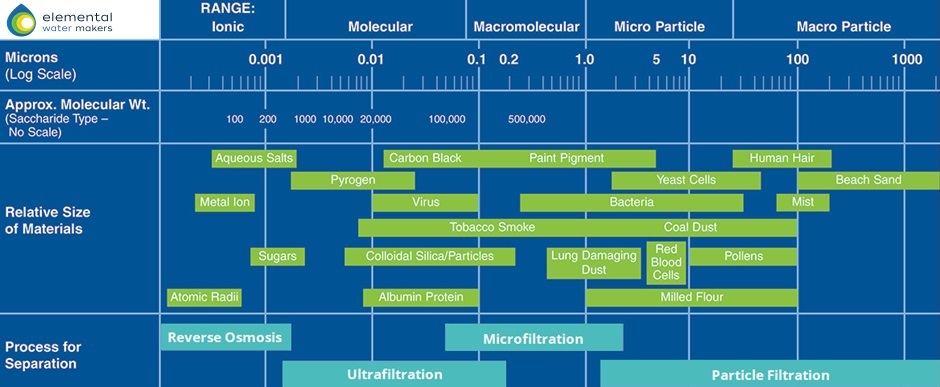
Filtration spectrum that shows the materials removed by reverse osmosis
How much energy does a reverse osmosis desalination system use? #
Energy consumption in reverse osmosis desalination depends heavily on the salinity of the source water and the system’s design. Seawater requires significantly more pressure than lower-salinity sources, which means more energy per liter produced. However, modern systems with energy recovery devices can reduce consumption dramatically compared to older technologies, achieving savings of up to 70% over conventional desalination methods.
Energy recovery works by capturing the pressure energy still contained in the concentrated brine stream as it leaves the membrane. Instead of wasting that pressure, the system transfers it back to the incoming seawater feed, reducing the load on the high-pressure pump. This innovation, originally developed for large-scale industrial plants, has been adapted for smaller systems and is a key reason why efficient desalination systems today are far more cost-effective to operate than they were a decade ago.
Can reverse osmosis desalination run on solar power? #
Yes, reverse osmosis desalination can run entirely on solar power. Solar-powered RO systems use photovoltaic panels to generate electricity, which drives the high-pressure pump and all other system components. This makes them particularly well suited for remote coastal locations where grid electricity is unavailable, unreliable, or very expensive. Off-grid solar desalination is a proven technology with installations operating reliably across tropical and subtropical regions worldwide.
The key to making solar-powered RO work efficiently is matching the system’s energy demand to the available solar resource. Energy recovery technology plays an important role here too, since lower energy consumption means the system can run effectively on a smaller solar array. Systems are typically sized to produce fresh water during daylight hours, with storage tanks holding enough supply to cover nighttime and cloudy-day demand. A small solar desalination system typically requires around 25 to 50 square meters of total space, making it practical even on constrained sites.
For locations where grid power is available but expensive, a hybrid approach is also common, using solar as the primary energy source and the grid as a backup. You can explore how plug-and-play solar desalination works in practice to understand the full range of off-grid options.
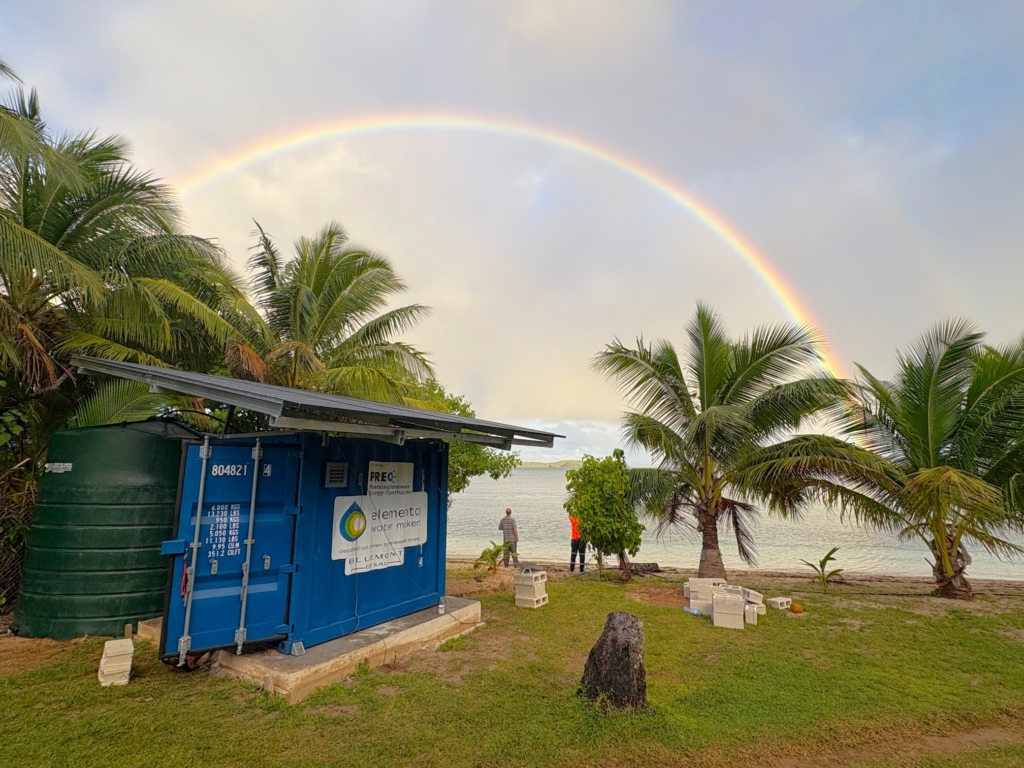
Solar desalination system using reverse osmosis technology
What is the difference between reverse osmosis and other desalination methods? #
The main alternative to reverse osmosis is thermal desalination, which boils seawater and collects the condensed steam as fresh water. Reverse osmosis is a pressure-driven membrane process, not a heat-driven one. This distinction matters because RO systems consume far less energy than thermal methods, require no heating infrastructure, and can scale down to small capacities without becoming prohibitively expensive.
Thermal desalination technologies such as multi-stage flash and multi-effect distillation were the dominant methods for decades, particularly in the Middle East where waste heat from power plants was available. They produce very high-quality water but at significant energy cost. Reverse osmosis overtook thermal methods as the global standard for new desalination capacity because the energy gap between the two approaches is substantial, and membrane technology has continued to improve in both performance and durability.
Electrodialysis is another membrane-based method, but it uses electrical current rather than pressure to move ions across membranes. It is more effective at lower salinity levels and less practical for open seawater desalination, where RO remains the more efficient and widely deployed choice.
How long does a reverse osmosis desalination system last? #
A well-maintained reverse osmosis desalination system can operate reliably for 15 years or more. The core structural components, including the pressure vessels, frames, piping, and energy recovery devices, are designed for long service life in coastal environments. Membranes and consumable filters require periodic replacement, typically every two to five years depending on water quality and operating conditions, but these are routine maintenance items rather than signs of system failure.
Longevity depends on three main factors: build quality, operating conditions, and maintenance discipline. Systems designed for harsh coastal environments with corrosion-resistant materials and robust engineering will consistently outlast cheaper alternatives. Remote monitoring capabilities help operators catch performance changes early, before small issues develop into costly problems. Chemical-free operation also reduces wear on internal components compared to systems that rely on chemical dosing, which can degrade seals and membranes over time.
How Elemental Water Makers helps with reverse osmosis desalination #
We design and supply small-scale reverse osmosis desalination systems built specifically for coastal locations where fresh water is scarce and energy costs are high. Our systems are modular, chemical-free, and engineered for long-term reliability in demanding environments. Here is what we bring to each project:
- Energy-efficient design: Our systems use advanced energy recovery technology to reduce consumption by up to 70% compared to conventional methods.
- Off-grid and grid-connected options: We offer both solar-powered off-grid systems and electrically connected solutions for commercial applications.
- Plug-and-play deployment: Our containerized units are pre-assembled and tested before delivery, so installation is straightforward. Small systems typically take a few days to install, while larger systems may require several weeks.
- Remote monitoring: All systems include monitoring capabilities so performance can be tracked and managed without on-site visits.
- WHO-standard water quality: Every system is designed to produce water that meets WHO drinking water standards.
- Permit support: Elemental Water Makers can help with submitting the technical data that may be required to apply for permits locally.
Our systems are sized to produce between 5,000 and 100,000 liters of fresh water per day, with project costs typically ranging from €40,000 to €400,000 depending on capacity and configuration. If you are evaluating a reverse osmosis desalination solution for your location, we are happy to help you find the right fit. Get in touch with us to discuss your project.
Frequently Asked Questions #
How do I know if a reverse osmosis desalination system is the right solution for my location?
RO desalination is well suited for any coastal or island location where fresh water is scarce, expensive to import, or unreliable. The key factors to assess are your daily water demand, the salinity and quality of your source water, your available energy supply, and your budget for both installation and ongoing operation. A site assessment by a qualified supplier will typically include a water source analysis and a system sizing recommendation, giving you a clear picture of what capacity and configuration makes sense before you commit.
What maintenance does a reverse osmosis desalination system actually require day to day?
Day-to-day maintenance is minimal for a well-designed system. Operators typically monitor system pressure, flow rates, and water quality readings, which can be done remotely if the system includes monitoring capabilities. Pre-filters need periodic inspection and replacement depending on source water quality, and the membranes require occasional chemical cleaning to prevent fouling buildup. The most important habit is consistency: catching small performance changes early through regular monitoring prevents the kind of neglect that shortens system life.
What happens to the brine that the system discharges, and is it harmful to the environment?
The brine discharge from an RO system is concentrated seawater, typically two to three times saltier than the source water, with no added chemicals if the system operates chemical-free. When discharged responsibly through a properly designed outfall, it dilutes rapidly in the surrounding seawater and has minimal environmental impact. Siting the discharge point in an area with good water circulation and avoiding sensitive marine habitats such as seagrass beds or coral reefs are standard best practices that most permitting authorities will require you to demonstrate.
Can a small RO desalination system supply enough water for a whole community or resort?
Yes, small-scale RO systems are regularly used to supply entire communities, resorts, and island facilities. A system producing 50,000 liters per day, for example, can comfortably meet the drinking and domestic water needs of several hundred people, depending on consumption patterns. Systems can also be scaled up by adding modules, making it possible to start with a capacity that matches current demand and expand as the community or facility grows without replacing the entire installation.
What is the biggest mistake people make when choosing a desalination system?
The most common mistake is prioritizing low upfront cost over total cost of ownership. A cheaper system that uses more energy, requires more frequent membrane replacements, or lacks corrosion-resistant materials will cost significantly more to operate over its lifetime, often erasing any initial savings within the first few years. Evaluating systems on energy consumption per liter produced, expected membrane lifespan, build quality for coastal environments, and the supplier’s track record gives a much more accurate picture of long-term value.
How long does it take from ordering a system to having it operational on site?
Lead times vary depending on system size and configuration, but for pre-engineered, containerized units the process from order to delivery typically ranges from a few months to around six months. Installation itself is relatively fast for plug-and-play systems, with small units often commissioned within a few days and larger systems within a few weeks. Permitting timelines are often the biggest variable and can differ significantly between countries and regions, so starting the permit application process early is strongly recommended.
Does the water produced by reverse osmosis taste different from regular tap water, and is it safe to drink directly?
RO-produced water meets WHO drinking water standards and is fully safe to drink directly from the system. Because the membrane removes nearly all dissolved minerals, the water can taste noticeably flat or neutral compared to mineral-rich tap water. This is why post-treatment remineralization is commonly included in desalination systems, reintroducing a controlled level of minerals such as calcium and magnesium to improve taste and ensure the water is physiologically balanced for regular consumption.